Glass City
Country
Germany
Language
German
Year
1914
Source form
Architectural manifesto, speculative fiction, and utopian architectural theory.
Source-world
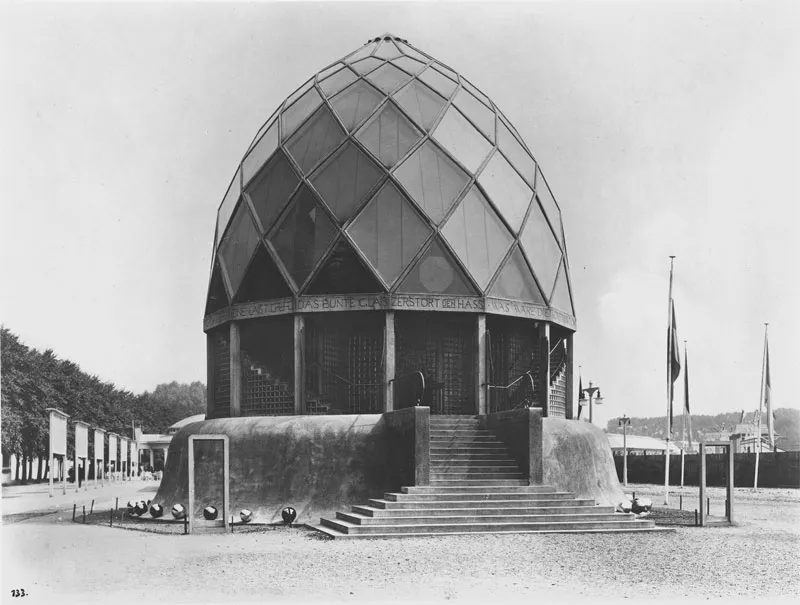
Paul Scheerbart's Glass City belongs to the German Expressionist imagination of the early twentieth century. Rather than describing a single realizable building, Scheerbart envisioned an entire civilization transformed through glass architecture. His principal text, Glasarchitektur (Glass Architecture, 1914), together with novels such as Lesabéndio (1913), imagines cities in which coloured glass, transparency, light, and crystalline structures reshape perception, social relations, and culture. The Glass City exists not as a practical urban proposal but as a literary and architectural speculation that profoundly influenced Expressionist architects, particularly Bruno Taut and the Glass Chain correspondence.
Construction
The Glass City consists of buildings made almost entirely from coloured, translucent, and reflective glass. Walls, roofs, floors, domes, bridges, towers, staircases, and public squares are constructed from transparent or semi-transparent materials that continuously refract sunlight and artificial illumination. Mechanical lighting systems, mirrors, prisms, fountains, and coloured illumination transform architecture into an optical environment. Instead of opaque masonry, the city employs crystalline surfaces that produce constantly changing visual effects through reflections, refractions, and colour transformations.
Scheerbart repeatedly imagined glass architecture as extending beyond individual buildings toward an entire planetary environment. Houses become luminous objects, cities become enormous light machines, and architecture itself functions as an instrument for producing new perceptual experiences.
Operation
The Glass City operates primarily through light. Sunlight enters coloured glass surfaces, producing shifting chromatic effects that change throughout the day and across the seasons. Artificial illumination extends these transformations into the night, making the city a continuously changing visual environment.
Rather than transmitting information or calculating data, the apparatus transforms perception itself. Citizens inhabit spaces where colour, transparency, reflection, and movement dissolve conventional distinctions between interior and exterior, public and private, nature and architecture. The city becomes an immersive optical medium that continually reorganizes sensory experience.
Architecture thus functions as an environmental interface: instead of merely sheltering human activity, it actively produces new forms of seeing, feeling, and inhabiting the world.
Modes
Glass, coloured light, transparency, reflection, refraction, crystalline geometry, architecture, landscape, atmosphere, illumination, movement.
Interface / user position
The user is an inhabitant immersed within a continuously changing optical environment. Rather than operating a discrete machine, the individual experiences the city itself as an interface that reorganizes perception through movement, light, and colour. The observer becomes part of an architectural medium whose effects emerge through bodily navigation and environmental immersion.
Epistemic promise
Perceptual transformation; sensory renewal; expanded environmental awareness; aesthetic education through architecture; the creation of a new relation between humans, technology, and nature. Scheerbart proposes that changing the material conditions of perception can transform consciousness itself.
Political / social stakes
The Glass City imagines architecture as a medium of cultural transformation rather than merely urban planning. Glass promises openness, mobility, internationalism, and liberation from the heaviness of nineteenth-century stone architecture. At the same time, the project embodies a distinctly modern belief that technological environments can reshape human behaviour and social life.
Unlike technocratic projects such as Buckminster Fuller's Geoscope or Paul Otlet's Mondothèque, Scheerbart's city is not organized around information, prediction, or administration. Its politics are aesthetic rather than bureaucratic: social transformation occurs through the reconfiguration of perception, atmosphere, and everyday experience. Nevertheless, the Glass City shares with other modern utopian media imaginaries the conviction that a carefully designed environment can produce a fundamentally different society.
References
Scheerbart, Paul. Glass Architecture (Glasarchitektur). Berlin: Verlag der Sturm, 1914.
Scheerbart, Paul. Lesabéndio: An Asteroid Novel. 1913.
Bruno Taut. Alpine Architecture. Berlin: Folkwang Verlag, 1919.
Whyte, Iain Boyd. The Crystal Chain Letters: Architectural Fantasies by Bruno Taut and His Circle. Cambridge, MA: MIT Press, 1985.
Bletter, Rosemarie Haag. The Interpretation of the Glass Dream: Expressionist Architecture and the History of the Crystal Metaphor. Journal of the Society of Architectural Historians 40, no. 1 (1981): 20–43.
Vidler, Anthony. The Architectural Uncanny: Essays in the Modern Unhomely. Cambridge, MA: MIT Press, 1992