GraveTech Shrouds
Country
Canada / France
Language
English
Year
2024
Source form
Science-fiction film; body horror; speculative media technology.
Source-world
The GraveTech Shrouds belong to David Cronenberg's The Shrouds (2024), a near-future world where digital technologies extend mourning beyond death. The film imagines a commercial infrastructure that allows relatives to observe the decomposition of buried bodies through networked burial shrouds equipped with sensors and three-dimensional imaging systems. Developed by the entrepreneur Karsh after the death of his wife, GraveTech transforms the cemetery into a continuous media environment where death remains permanently accessible through digital interfaces.
Unlike supernatural communication with the dead, the film insists on technological mediation. The deceased do not return; instead, their material decay becomes a persistent stream of visual data. Cronenberg situates the apparatus within a world of AI assistants, encrypted networks, corporate infrastructures, data breaches, and geopolitical conspiracy, making grief inseparable from surveillance and digital mediation.
Construction
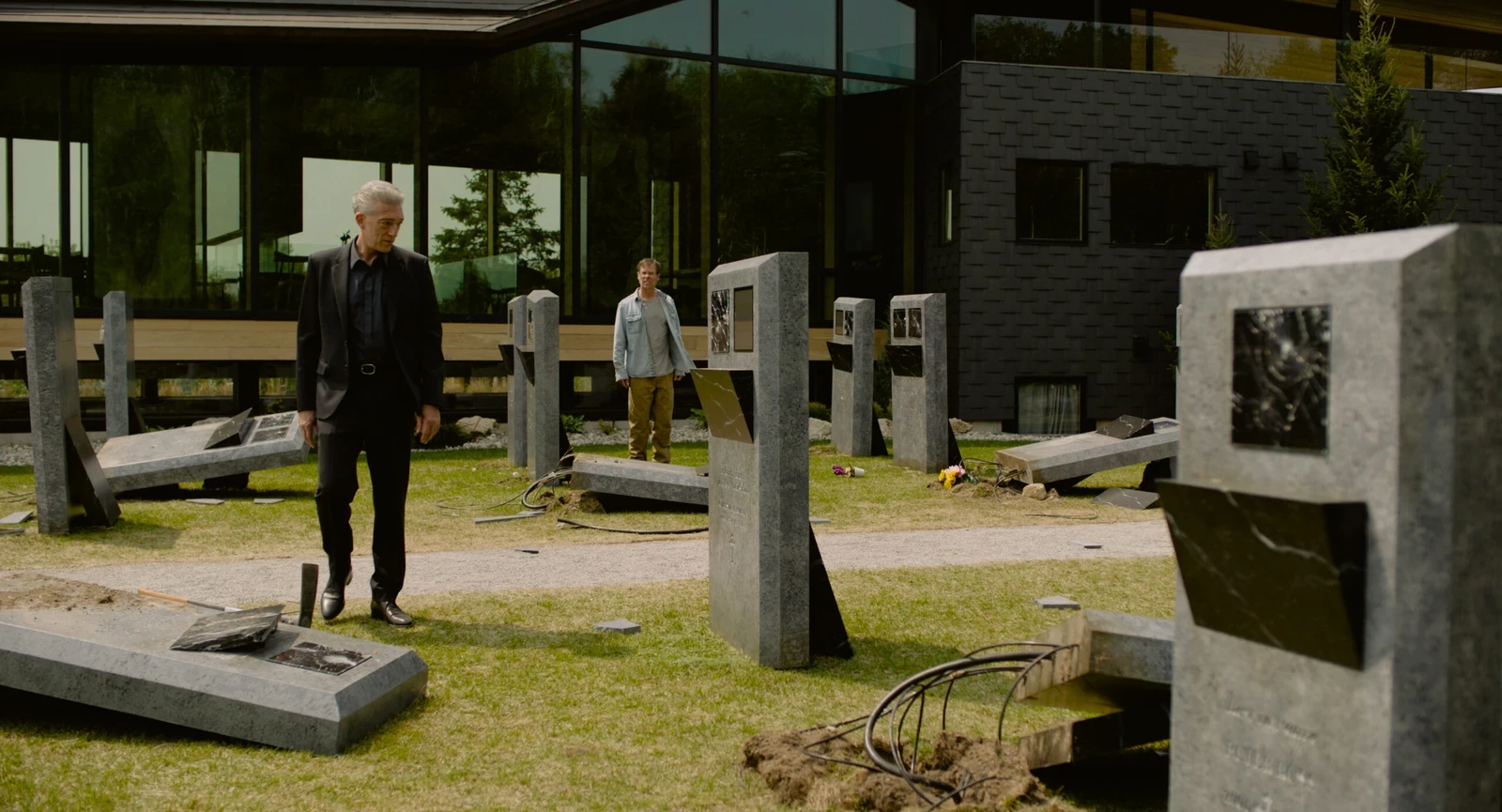
The apparatus consists of a modified burial shroud embedded with imaging sensors, cameras, and biometric recording devices wrapped around the corpse before burial. Each grave is connected to the GraveTech network through an intelligent tombstone that functions simultaneously as monument, display terminal, communication node, and network relay.
The cemetery itself operates as distributed digital infrastructure. Buried bodies, sensor-equipped shrouds, servers, encrypted databases, mobile applications, three-dimensional rendering software, and artificial intelligence assistants collectively constitute a single technical system. Rather than treating the grave as the endpoint of communication, GraveTech converts it into a permanently networked media device.
Operation
After burial, the sensor-equipped shroud continuously records the changing condition of the corpse. These measurements are transmitted through the GraveTech network, where they are reconstructed as navigable three-dimensional models accessible through mobile applications and cemetery displays.
Users may inspect the body from multiple viewpoints, repeatedly returning to the same corpse as decomposition progresses. Observation therefore becomes continuous rather than ceremonial. The apparatus transforms biological decay into persistent visual information and converts mourning into an ongoing act of remote monitoring.
The machine does not attempt resurrection or simulation. Instead, it insists upon the visibility of physical decomposition itself. Death becomes a measurable, networked process whose temporal unfolding is transformed into digital visualization.
Modes
Corpse; textile; sensor data; medical imaging; three-dimensional visualization; network transmission; mobile interface; gravestone display; database; artificial intelligence; architecture; bodily decay; surveillance.
Interface / user position
The user occupies the position of a remote mourner, simultaneously observer, family member, and data consumer. Rather than encountering the dead through ritual visits or memory, the user navigates digital representations generated from the continuing material transformation of the corpse.
The apparatus also positions the deceased as involuntary data producers. Even after biological death, the body continues to generate information through decomposition, making the corpse itself part of an information infrastructure. The cemetery becomes both memorial and monitoring system.
Epistemic promise
The GraveTech Shrouds promise unprecedented access to death by eliminating the traditional separation between the living and the buried. Instead of symbolic remembrance, they offer continuous empirical observation of bodily transformation. Death becomes visible, measurable, and permanently available.
The apparatus claims to produce a more truthful relationship to mortality through technological transparency. It rejects both religious transcendence and psychological repression in favour of direct visual evidence. Knowledge emerges not from memory or belief but from uninterrupted observation of biological materiality.
Political / social stakes
The Shrouds extend contemporary cultures of surveillance into the domain of mourning. They transform intimate grief into networked data, making death subject to continuous recording, storage, ownership, and potential exploitation. The body remains embedded within technical infrastructure after death, raising questions about privacy, consent, and digital inheritance.
Cronenberg also exposes the commodification of bereavement. GraveTech operates simultaneously as emotional service, technological platform, and commercial enterprise, suggesting that mourning itself has become a subscription-based media experience. When the cemetery network is hacked and graves are vandalized, the film demonstrates that the digital afterlife is vulnerable to the same forms of cyberattack, political manipulation, and corporate control that structure contemporary information systems.
References
Cronenberg, David, dir. The Shrouds. France/Canada: SBS Productions, Prospero Pictures, Saint Laurent Productions, 2024.
Janus Films. The Shrouds. Accessed July 2026. https://www.janusfilms.com/films/2266
Saint Laurent Productions. The Shrouds. Accessed July 2026. https://saintlaurentproductions.ysl.com/the-shrouds
Film at Lincoln Center. The Shrouds (NYFF62 programme notes). Accessed July 2026. https://www.filmlinc.org/nyff2024/films/the-shrouds/